I've posted the final grades. The grade scale for the final was
- 57–81: A- to A
- 43–56: B- to B+
- 32–42: C to C+
Anything lower than that is a D or an F. And here's a reminder of how I do the grading for this class.
I'll officially submit the grades to the registrar tomorrow. Thanks for all your work this semester, and have a great summer.
Here are the solutions to the final, version A and version B. I'll post your scores on the final and your class grades later today.
Here are the solutions to that Taylor series problem we did in class today. The other problems we talked about in class today are from the 2023 final, and you can find the solutions in the exam archive
The final is next week, May 18th, in our normal classroom at our normal class time. The exam will be the same basic format as the midterm. You can use any calculator, but you can't use a phone or computer. You can have a sheet of notes, which must be in your own handwriting on normal-sized 8.5 by 11 inch paper. You can write on both sides of the sheet. I'll include this table of trigonometric integrals on the exam. The exam will go from 10:10 to 12 with no breaks. In particular, I'd like everyone to remain in the room the entire time.
The best resource for doing well is the old exams. The last time I taught the class, I gave three exams, so both exam #3 and the finals are good for studying. You can find more practice exams on other professors' websites (like Prof. Joseph Maher's). The best way to study for an exam is to practice exam-like problems in an exam-like setting. It's best not to look at the solutions until you're done solving (or trying to solve) all the problems on your own.Here are the questions from today's class, along with the answers to problem #1. We'll talk about the rest of it next class.
Here are the solutions to today's quiz.
Our department has finished scheduling the finals, and our final will be held on Monday, May 18th, at our normal class meeting time in our normal meeting place. I've added it to the calendar.
Here are the solutions to today's quiz. Also, here is the animation I showed you today illustrating Taylor polynomials converging to the sine function.
I fixed the setting on Brightspace that was hiding your grades. They should all be visible now. Sorry for the confusion, and have a great break.
I've posted your midterm scores on Brightspace. You can interpret your score as follows:
- 39–53: A- to A
- 30–39: B- to B+
- 22–29: C to C+
Anything lower than that is a D or an F. And here's a reminder of how I do the grading for this class.
Overall, the class did quite well on this exam. If that's not the case for you and you'd like to discuss your situation with me, send me an email or come to my office hours at the end of the break. The drop deadline is April 13th.
I had announced that the Section 10.3 homework would be due next week, but I messed up the date for it so it was still set to be due today. I've reopened it now until next week.
I'll post solutions to the exam tomorrow and if all goes well, I'll get it graded tomorrow too. Good luck and have a good break.
Our second midterm is next week, on Monday, March 30th. So we'll have no quiz this week.
The midterm will cover through Section 10.3. All the midterm policies will be the same as for the first midterm: You can use any calculator, but you can't use a phone or computer. You can also have a sheet of notes, which must be in your own handwriting on normal-sized 8.5 by 11 inch paper. You can write on both sides of the sheet. I'll include this table of trigonometric integrals on the exam. The exam will go from 10:10 to 11:50 with no breaks. In particular, I'd like everyone to remain in the room the entire time.
The best resource for doing well is the old exams. Midterm 2 and Practice Midterm 2 from these exams also go through Section 10.3, so all of the problems on those exams are suitable for you. The best way to study for an exam is to practice exam-like problems in an exam-like setting. It's best not to look at the solutions until you're done solving (or trying to solve) all the problems on your own.Just a note that on Monday, March 23rd, office hours will be from 1:15 to 2:15 instead of the usual 12-1:30.
Here are the solutions to today's quiz.
There will be a quiz in class on Wednesday on Sections 7.5 and 7.6, modeled on the homework.
I didn't quite finish Section 7.7 in class today, so I've pushed the Section 7.7 homework back to the next homework assignment. It's only the last question that we haven't talked about, though.
Here are the solutions to the quiz.
As I mentioned in class today, we'll have quiz on Wednesday on Sections 7.1 and 7.3. It will be similar to the homework that was due today.
On the quiz, I'll include this table of trigonometric integrals. Also you can have a sheet of notes (one page, front and back, just like on the midterm), because it is tough to do trigonometric integration (Section 7.3) without some reference.
I want to make sure that everyone in our class knows about the Mathematics Tutoring Center in 1S-214. You can see its hours by following that link. There are other tutoring resources available, like the OAS tutoring in 1L-117 (schedule), but the tutors in the Mathematics Tutoring Center are chosen by the department and will definitely be able to help you, whereas the tutors elsewhere might not be able to help with MTH 232.
I've posted your midterm scores on Brightspace. You can interpret your score as follows:
- 47–65: A- to A
- 35–46: B- to B+
- 25–34: C to C+
Anything lower than that is a D or an F.
In the interest of transparency, and also because I hate answering questions about I assign grades, let me explain in as much detail as possible how I assign grades for the class. For each midterm and final, after I grade the test, I make a gradescale as above. I don't set the scale to make a certain number of A's, B's, and C's. Rather, I look at the tests and try to judge what scores match my expectations for what merits an A, B, or C. This means that if everyone in the class does well, I set the gradescale so that there are more A's.
When it comes time to assign final grades for the course, I use the gradescales to convert the midterm and final scores to a numerical scale of 0–100. In more detail, I convert the low end of the A range to 90, the low end of the B range to 80, etc. I set the high end of the A range to something above 100. For scores in the middle of a range, I interpolate linearly to convert them to the numerical scale. As a consequence, even though the gradescale for this exam says that 46 is a B+ and 47 is an A-, there is no big difference in getting a 46 rather than a 47 on this exam. When converted to the numerical scale, you'd just be getting an 89 instead of a 90 or something like that.
For the homework and quiz part of the grade, I also convert your scores to the numerical grade, though I'm a bit more ad hoc about it. Finally, I take all your numerical grades and compute a weighted average according to the weights given in the syllabus and arrive at your final numerical grades. Then, I make the final letter grades based on these. Roughly speaking, I'd convert numerical grades of 90 and above to an A or A-, grades of 80 to 90 to a B+, B, or B-, etc., but I use my judgment when setting the cutoffs (it's not like I'm giving people who got a numerical grade of 89.9 a B+).
One very special grading policy that I have: If you ask me whether I grade on a curve, I will ask you questions about what you mean by grading on a curve, probably until you give up asking your question. (If you can explain to me what you mean by grading on a curve, I am happy to answer the question, but it is not very common that anyone has a clear sense of what it means to grade on a curve.) I do hope that my explanation here is enough that you'll understand how the grading works.
Here are the slides from today's class. See you on Wednesday for the midterm. Don't hesitate to email me if you have any questions as you review.
Our first midterm is on Wednesday, February 25th. Here are some old exams you can use to help you study. The best way to study for an exam is to practice exam-like problems in an exam-like setting. It's best not to look at the solutions until you're done solving (or trying to solve) all the problems on your own.
The exam will cover up to Section 6.4. You can use any calculator, but you can't use a phone or computer. You can also have a sheet of notes, which must be in your own handwriting on normal-sized 8.5 by 11 inch paper. You can write on both sides of the sheet. The exam will go from 10:10 to 11:50 with no breaks. In particular, I'd like everyone to remain in the room the entire time with no bathroom breaks.
Our schedule is a bit different for the next two weeks. There's no class on Monday for President's Day, and we won't have a quiz on Wednesday. The next homework isn't due until the following Monday, which is February 23rd. The next homework assignment after that won't be due until March 9th.
And then we have our first midterm on Wednesday, February 25th.Here are the solutions to yesterday's quiz.
I promised to link to some images showing a solid decomposed into discs and into shells. Actually, I found it a lot harder to find good images than I expected. I settled on these pictures (and also data files for 3-d printing) of a decomposition of a cone into discs and cylinders. They're simple but they get the point across.
Here are the solutions to today's quiz.
I've finished looking over Quiz 1 and will hand them back on Monday. As I said, everyone gets credit on this quiz just for showing up, but I put some comments upin Brightspace (and I also wrote things on the quizzes). The comments on Brightspace either say that I have concerns about your writing or your Calculus I skills or both, or if I didn't have any concerns I just wrote “good”.
You shouldn't necessarily take these concerns too seriously, especially those about writing. Here I am asking you to change some writing habits that you've built up over a long time, and it's fine if it takes a bit of time to adjust. If I wrote that I have concerns about your writing, please take another look at my guide to writing algebra. Here are two more writing issues I saw while grading:
- Use of the arrow symbol. It is very common for students to abuse the arrow symbol. For example, on one quiz somebody wrote \( 1 \to 0 \), \( x^2\to 2x\), and \( \ln x\to\frac1x \), with the arrow denoting “has derivative”. But on the same quiz, it also says \( 0 +\frac{2x}{x} + \ln x \to \frac{2x}{x} + \ln x \), with the arrow denoting “is equal to”. Neither of these uses is correct. The only thing that the arrow symbol should be used for in this class is writing limits. For the first use, write \(\frac{d}{dt}(x^2) = 2x \). For the second, write an equal sign.
- Writing all over the page. I realize that on an exam, your work won't necessarily be organized perfectly. But please don't scribble all over the page. Start at the top left and work your way down. If you want to scribble some things down as you get started, use scratch paper.
I realize this is probably the first time anyone has ever critiqued your mathematical writing or even seemed to care at all about the way you're writing! For some reason, there's a culture in math education below the advanced level of not caring about writing at all (in the United States, at least). It's as if students could just scribble sentence fragments with no punctuation on an English paper, and then when they got to college their professors asked them to write an essay, marked them down for not being able to write, and then expected English majors to just sort of figure out how to write as they worked their way through their classes. I'm trying to give you some explicit instruction in how to write instead of forcing you to figure it out on your own. It benefits the readers of whatever you write, but it will also benefit you: writing math clearly will help you understand it better, too.
If I wrote down that I had concerns about your Calculus I skills, you may or may not need to worry. If you were feeling sort of rusty and then forgot some basics doing a quiz that you couldn't really prepare for on the second day of class, and your skills come right back after you do the first few homework assignments, then you don't have anything to worry about. But if you have more serious trouble with the material from Calculus I, you will struggle with this class. It does just pick up where Calculus I left off, and in particular you need to be able to compute derivatives easily.
Here are my videos for this class, for you to use an extra resource. You can find them here and also by going to the materials page.
- Integrals.1
- Integrals.2
- Integrals.3
- 5.7, lecture 1
- 5.7, lecture 2
- 5.8, lecture 1
- 5.8, lecture 2
- 6.1, lecture 1
- 6.1, lecture 2
- 6.1, lecture 3
- 6.2, lecture 1
- 6.2, lecture 2
- 6.2, lecture 3
- 6.3, lecture 1
- 6.3, lecture 2
- 6.4, lecture 1
- 6.4, lecture 2
- 6.4, lecture 3
- 7.1, lecture 1
- 7.1, lecture 2
- 7.1, lecture 3
- 7.2, lecture 1
- 7.3, lecture 1
- 7.3, lecture 2
- 7.5, lecture 1
- 7.5, lecture 2
- 7.5, lecture 3
- 7.6, lecture 1
- 7.7, lecture 1
- 7.7, lecture 2
- 7.7, lecture 3
- 10.1, lecture 1
- 10.2, lecture 1
- 10.2, lecture 2
- 10.2, lecture 3
- 10.3, lecture 1
- 10.3, lecture 2
- 10.3, lecture 3
- 10.4, lecture 1
- 10.5, lecture 1
- 10.5, lecture 2
- 10.5, lecture 3
- 10.6, lecture 1
- 10.6, lecture 2
- 10.6, lecture 3
- 10.7, lecture 1
- 10.7, lecture 2
- 10.7, lecture 3
- 10.8, lecture 1
- 10.8, lecture 2
- 10.8, lecture 3
- 8.2, lecture 1
- 8.2, lecture 2
- 11.1, lecture 1
- 11.1, lecture 2
- 11.1, lecture 3
- 11.2, lecture 1
- 11.2, lecture 2
- 11.3, lecture 1
- 11.3, lecture 2
- 11.4, lecture 1
- 11.4, lecture 2
This is just a reminder to make sure that you can log into Webwork (see the homework page for instructions). The first assignment is due on Monday.
Here are the solutions to today's quiz.
I mentioned over Zoom that we will have quiz on Wednesday (tomorrow). The point of the quiz is to give you a chance to learn how I want you to write your solutions in this class (and also in other classes going forward). Unlike other quizzes in the class, this one is meant to be purely a learning experience, and you'll get full credit just for showing up. Also, here are the slides from Zoom (though reading the rest of this post is probably more helpful than looking at these slides).
To review what I told you in class, there are two different skills involved in algebra. The first of them is transforming expressions. Usually this is just a step in a bigger problem. An example of this is expanding a polynomial, like this:
\[ \begin{aligned} (s+1)(s^2-2s-5) &= s(s^2-2s-5) + 1(s^2-2s-5)\\ &= s^3 - 2s^2 - 5s + s^2 - 2s - 5\\ &= s^3 - s^2 - 7s - 5 \end{aligned} \]What I've written here is six expressions all connected by equal signs. It's written on six lines, with the last five starting with an equal sign, but that's just for typographical reasons. It could equally well be written on one line, like this:
\[ (s+1)(s^2-2s-5) = s^3 - 2s^2 - 5s + s^2 - 2s - 5 = s^3 - s^2 - 7s - 5. \]When you're transforming expressions, write a chain of equalities as above. Don't just write a pile of expressions without those equal signs to explain the relationship between them. As in the example from class, if you're trying to differentiate \( (3x+1)(x+2) \), your solution should look like this:
\[ \begin{aligned} \frac{d}{dx}\Bigl((3x+1)(x+2)\Bigr) &= \frac{d}{dx}\Bigl( 3x^2 + x +6x + 2\Bigr)\\ &= \frac{d}{dx}\Bigl( 3x^2 + 7x + 2\Bigr) = 6x + 7. \end{aligned} \]Your solution should not be written like:
\[\begin{aligned} (3x+1)(x+2)\quad 3x^2+x+6x+2\quad 3x^2+7x+2\quad 6x+7 \end{aligned} \]The other algebraic skill is solving equations. Generally speaking, the way we solve equations is by transforming them into different equations (with the same solutions!) that are easier to solve. And the way that we transform the equations is by doing the same thing to both sides, e.g., adding the same number to both sides of an equation or multiplying both sides of an equation by the same number. When you're solving equations, write down one equation after another, each transformed from the previous one. Do not cross out or write on top of an equation To give a simple example, let's say you want to solve the equation \( 3x+1=5 \). Your solution should look like this:
\[\begin{aligned} 3x+1&=5\\ 3x &= 4\\ x&=\tfrac43 \end{aligned} \]Your solution should not look like:
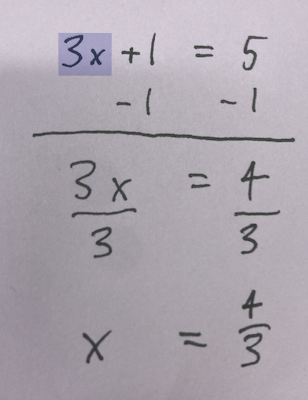
I get the sense that high-school teachers are telling students to write their solutions like this. In my experience it's a tough habit for students to break. But for various reasons I'll list now, I do want you to break it:
- Let's say you're solving the equation \( \frac{x}{2} + 7 = 18 \).
I cannot tell you how many times I see solutions like:
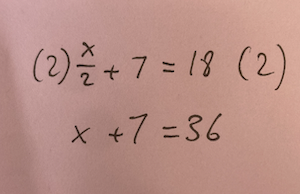
We are supposed to multiply both sides by 2, but here the multiplication is read as only applying to the first term on the left-hand side. You can make a mistake however you're writing things, but I think it's easier to make a mistake when you write on top of equations or cross things out. The equations get messier and harder to read, and it's very easy to neglect parentheses. - Your solution should be a record leading from your starting equation to the changed, equivalent equations you get to along the way. If you write on top of them or cross things out, we lose the record.
- Philosophically, when we write math, we're writing down a logical argument. The story is that we're trying to find solutions to \( 3x + 1 = 5 \), and we know that \( 3x = 4 \) has the same solutions, and then we know that \( x = \frac43 \) has the same solutions, and now we're down to an equation whose solutions (well, there's only one) are incredibly obvious. Math papers really are written like this, with much more English text than equations. I don't expect you to be quite so verbose when you're giving answers on a quiz, but writing down those three equations one after another is a good, quick way of giving that story. Writing down the equations and then writing on top of them is not.
Here are links to two lecture videos for you to watch before class on Wednesday. I recommend that you watch them right away after our first meeting on Zoom, and then get started on the first assignment.
Here's an extra video in case you want more, but you don't need to watch it (I'll cover it on Wednesday in class).
Welcome to Math 232, Calculus II. We meet in room 1S-115 from 10:10 to 11:50 on Mondays and Wednesdays. The first class is on Monday, January 26th.
The official textbook for the class is Calculus: Early Transcendentals by Rogawski. A used copy is as good as new. It's also fine to use OpenStax Calculus, a free textbook that you can download. Its content is very similar to the Rogawski textbook.
You can find some important information on the class in the syllabus. A more detailed schedule for the class is given in this calendar. The class will include online homework through WebWork (see Homework).
I'll see you all in class on Monday and am looking forward to a good semester!