Homework 2.3 2.7
Announcements
Our first exam is scheduled for Wednesday, October 7th.
- The exam will probably cover everything up to and including Section 3.3. I'll finalize this next week.
- You can use any calculator, graphing, scientific, whatever. You cannot use a computer or a phone, even if you have a calculator app on your phone and promise to only use it. No exceptions, sorry. None of the problems will specifically require a calculator, since exact answers are preferred anyhow.
- You may bring to the exam a one-page, two-sided sheet of notes in your own handwriting. I want it to be written in your own handwriting because the process of making a notesheet is helpful for studying, and I don't want people downloading or xeroxing someone else's notesheet. Also I want to avoid weird tiny print, magnifying glass scenarios with typed sheets.
- Please don't use the bathroom, etc., during the exam. This is not an absolute prohibition, since I realize sometimes life compels people to leave the room in some way. I don't like imposing this policy, because I think it's disrespectful to you students, but in recent semesters I've had a hard time preventing cheating, and I don't want to have an atmosphere where students do that.
Here are some old exams that you can use to prepare. There are solutions posted as well. The best way to study is to take practice exams under exam-like conditions. The solutions are useful to check your answer after you've solved it, but it won't help you much if you just study by reading the solutions. Even if you've completely stuck on a problem, you'll do better if you email me for a hint (or ask AI for a hint) rather than look at the solution.
There will be a quiz next week, on Wednesday, September 30th. There will be one question from Section 2.5 and one from Section 2.7.
I had messed up when assigning the last homework set on Webwork, and it wasn't showing up for anybody. I've fixed it now and you should see the assignments now. Since it wasn't available for a while, however, I've delayed its due date to Monday, Sptember 28th. I'd recommend doing it sooner, though, if you can manage it.
Here are solutions to today's quiz.
There will be a quiz at the end of class on Wednesday. There will be a problem on trig equations/inverse trig functions and another on exponential equations and logarithms.
Here are solutions to today's quiz. Today's quiz was more about writing than mathematics, though, so the solutions themselves aren't so important.
I mentioned in class that we will have a quiz on Wednesday. The point of the quiz is to give you a chance to learn how I want you to write your solutions in this class (and also in other classes going forward). Unlike other quizzes in the class, this one is meant to be purely a learning experience, and you'll get full credit just for showing up.
To review what I told you in class, there are two different skills involved in algebra. The first is transforming expressions. Usually this is just a step in a bigger problem. An example of this is expanding a polynomial, like this:
\[ \begin{aligned} (s+1)(s^2-2s-5) &= s(s^2-2s-5) + 1(s^2-2s-5)\\ &= s^3 - 2s^2 - 5s + s^2 - 2s - 5\\ &= s^3 - s^2 - 7s - 5 \end{aligned} \]What I've written here is four expressions all connected by equal signs. It's written on three lines, with the last three starting with an equal sign, but that's just for typographical reasons. It could equally well be written on one line, like this:
\[ (s+1)(s^2-2s-5) = s^3 - 2s^2 - 5s + s^2 - 2s - 5 = s^3 - s^2 - 7s - 5. \]When you're transforming expressions, write a chain of equalities as above. Don't just write a pile of expressions, like \[ \begin{aligned} &(s+1)(s^2-2s-5) \\ &s(s^2-2s-5) + 1(s^2-2s-5)\\ & s^3 - 2s^2 - 5s + s^2 - 2s - 5\\ & s^3 - s^2 - 7s - 5 \end{aligned} \]
The other algebraic skill is solving equations. Generally speaking, the way we solve equations is by transforming them into different equations (with the same solutions!) that are easier to solve. And the way that we transform the equations is by doing the same thing to both sides, e.g., adding the same number to both sides of an equation or multiplying both sides of an equation by the same number. When you're solving equations, write down one equation after another, each transformed from the previous one. Do not cross out or write on top of an equation To give a simple example, let's say you want to solve the equation \( 3x+1=5 \). Your solution should look like this:
\[\begin{aligned} 3x+1&=5\\ 3x &= 4\\ x&=\tfrac43 \end{aligned} \]Your solution should not look like:
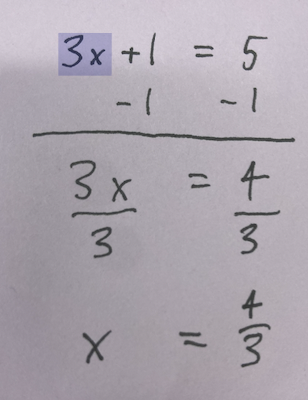
I get the sense that high-school teachers are telling students to write their solutions like this. In my experience it's a tough habit for students to break. But for various reasons I'll list now, I do want you to break it:
- Let's say you're solving the equation \( \frac{x}{2} + 7 = 18 \).
I cannot tell you how many times I see solutions like:
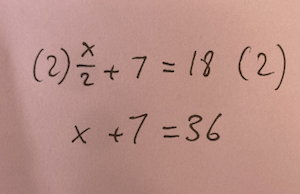
We are supposed to multiply both sides by 2, but here the multiplication is read as only applying to the first term on the left-hand side. You can make a mistake however you're writing things, but I think it's easier to make a mistake when you write on top of equations or cross things out. The equations get messier and harder to read, and it's very easy to neglect parentheses. - Your solution should be a record leading from your starting equation to the changed, equivalent equations you get to along the way. If you write on top of them or cross things out, we lose the record.
- Philosophically, when we write math, we're writing down a logical argument. The story is that we're trying to find solutions to \( 3x + 1 = 5 \), and we know that \( 3x = 4 \) has the same solutions, and then we know that \( x = \frac43 \) has the same solutions, and now we're down to an equation whose solutions (well, there's only one) are incredibly obvious. Math papers really are written like this, with much more English text than equations. I don't expect you to be quite so verbose when you're giving answers on a quiz, but writing down those three equations one after another is a good, quick way of giving that story. Writing down the equations and then writing on top of them is not.
Welcome to Math 231, Calculus I. We meet in room 3N-222 from 10:10 to 11:50 on Mondays and Wednesdays. The first class is on Monday, August 31st.
The official textbook for the class is Calculus: Early Transcendentals by Rogawski. A used copy is as good as new. It's also fine to use OpenStax Calculus, a free textbook that you can download. Its content is very similar to the Rogawski textbook.
You can find some important information on the class in the syllabus. A more detailed schedule for the class is given in this calendar. The class will include online homework through WebWork (see Homework).
I'll see you all in class on Monday and am looking forward to a good semester!